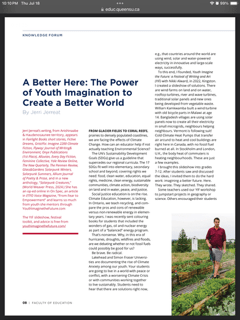
Knowledge Forum- article by J.Jerreat
This article is in the 2024 spring issue titled “Global Education” and can be read online. Published by Queen’s University. https://educ.queensu.ca/research/knowledge-forum

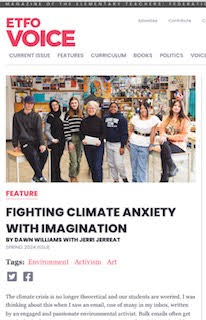
ETFO VOICE Magazine- article by D. Williams & J Jerreat
This article was in the SPRING 2024 issue and may be read online.
https://etfovoice.ca/feature/fighting-climate-anxiety-imagination
Knowledge Forum- article by J.Jerreat
This article is in the 2024 spring issue “Global Education” and can be read online at Published by Queen’s University. https://educ.queensu.ca/research/knowledge-forum
Why We Need Solarpunk Stories- On Spec Magazine (on website)
By Jerri Jerreat
Simon Fraser University has been studying the troubling rise of climate anxiety and climate depression among youth. They now offer climate anxiety and grief seminars (1). Then Lakehead University published their survey of Canadian youth, age 16-25. Nearly half reported that they think humanity is doomed. Thirty-nine per cent feel they should not have children. Seventy one per cent are angry at the government’s response to the climate crisis and sixty-nine per cent feel abandoned (2).
Those reports emerged before the summer of 2023. June’s deadly heat wave in Western Canada of 2021 should have woken up the country; somehow it did not. In 2022, the University of Waterloo released a paper naming fifteen cities across Canada that were likely to experience the urban heat island effect next, if the cities did not reduce their carbon footprint. (3). Mine was on the list. Perhaps yours, too?
Then came the summer of 2023. Wildfire smoke from Québec and northern Ontario blanketed our capital city, then Ontario, Québec, then spread outward. New York City shared the same dystopian yellow-grey skies as Toronto. Folks in B.C. already knew about keeping children inside, windows closed, from previous wildfires, but it was new to Ottawa. This period was followed by a heat wave across most of Canada, then terrible flooding in Nova Scotia, tornadoes touching down in Ottawa, and over 40,000 people evacuated from homes across B.C. and the Northwest Territories due to wildfires.
The planet’s oceans reached their hottest recorded temperatures ever.
What can science fiction writers do about this? Rather a lot. This is the time we need sci fi writers more than ever.
Writers are changemakers. If we can create a believable world on another planet, we can also write stories on future Earth so vivid, characters so relatable, that we’ll shift the mindset of our readers from —climate despair to hope. If we put our research and talents to work and write solarpunk.
Solarpunk is a science fiction, art, and social movement which shows us how things might improve if communities work together. Solarpunk shows us, at its most basic level, society with far better social equity and no fossil fuels.
How could your own region look, fifty or a hundred years from now, if everyone switched to cold climate heat pumps and we invested in excellent public transportation that was fossil fuel-free? Naturally all our electricity would have to be created from solar, wind, river, waves, tides, and other renewable methods. As well, we would have to create food a better way—without synthetic fertilizers. There might be a lot more plant-based meals on a future menu.
This takes research.
I wrote a dystopia long ago, after the Taliban first took over Afghanistan and stripped away women’s rights. I have read and enjoyed many dystopias. However, I see many youth now daily, and I am turning my back on dystopias or post-apocalyptic fiction.
Our youth are frightened about the future. Will there even be a future for them? I’ve met university students and people in their late twenties who don’t think they will have children because of the climate crisis. At Queen’s University, an extremely tall student, second or third year, approached me after my workshop on positive climate solutions. I was feeling ebullient.
He hesitated, frowned, appeared shy.
“Did you have a question?” I asked.
He blurted, “How do you—” He struggled to get the next word out, “hope?”
The news in biology is all bad, another student explained. Different species are going extinct every single day (4).
These conversations led me to create a festival for local youth called “Youth Imagine the Future”. It seemed like a great way to mentor young writers both in writing and in becoming active citizens. There can be a better future. We all have to work together on it.
Writers can show us how.
“Youth Imagine the Future: A Festival of Writing and Art” is now held in a large chunk of eastern Ontario. I created a slideshow of inspiring ideas that countries around the world are working on to help us to reduce fossil fuel consumption, to mitigate the climate crisis, and to restore biodiversity. I update the slideshow constantly, but there is never enough time to show it all. Jamaica and India are restoring their mangrove wetlands, both for biodiversity and to buffer their shorelines from hurricanes and erosion. Toronto, too, has been restoring their wetlands, creeks, and rivers as well. One story Toronto’s RAP (Remedial Action Plan) told us on a webinar was of a large wetland that had been drained and farmed for a century. RAP was able to revert the stream back into the area, and they were ready to replant native species. To their surprise, all the plants appeared in that first spring once water had been returned. The seeds had been lying dormant under the field for a hundred years. Fish returned, turtles, amphibians, butterflies, bees, a whole ecosystem.
There are an incredible number of amazing ecological inventions for the tech lovers being used around the world. The James Dyson award has been won by some of them. There is an “O Wind,” a small turbine in the pre-production stage in the UK, the size of a basketball, kinetic tiles creating lights in a soccer field in a Rio di Janeiro favela. In Heathrow Airport, stunning helix wind turbines being installed on tall buildings, and flexible, transparent solar panels are in the works thanks to a young Filipino inventor. Another Dyson award winner. It is made from the cellulose of old vegetables.
In Stockholm, Sweden, and in north London, UK, the body heat of commuters going through a train or subway station is being used to heat many other buildings, homes, and hot water. Other companies are working on more sustainable ways to store solar and wind energy to use at night or when it is not windy.
Brilliant? Yes. Science fiction? No.
But it could be.
A good dystopian novel can make a strong political statement and make us think. These days, the news is enough dystopia. Our youth need stories and novels to inspire them. They need stories to help make them picture a better future.
What might we see in a solarpunk setting of your next story?
In a solarpunk story, (an action-adventure, a comedy, a tense drama, or romance, etc.) the setting should show how the community has worked together to switch away from fossil fuels and old “Big Ag” methods. Enter community gardens, rooftop gardens, or hydroponic sprouts grown easily in a couple of windows. Enter regenerative farming, smaller co-ops, permaculture. Parking lots might have been pulled up, the dead dirt layered with leaves, compost and straw and become a large community food garden or a Miyawaki forest to return biodiversity, pollinators, and to lower the city’s heat. Indigenous people might be leading the projects, or even running the government. It could be better. Imagine.
Wave turbines might be working on old piers to create electricity, but shorelines will be replanted with native shoreline plants to help buffer extreme storms and shelter many species again. According to the United Nations, about 40% of the world’s living species live in or breed in a wetlands. Cities need ribbons of green running through them, and never lonely soldier trees lined up in a row every three metres, surrounded by pavement. A solarpunk future would show that.
Future cities should have sustainable, non-polluting public transportion. Vancouver has a small fleet of electric buses that recharge in five minutes. Sweden has a strip of road that EV vehicles can drive over to recharge. Germany has fast hydrogen-fuel-celled trains between cities—made in Canada. Japan has mag-lev trains (magnetic-levitating) for speed.
Sci-fi writers can research what is on the cutting edge today and show us a better tomorrow.
Even if we electrify our buildings, our transportation, improve our farming methods—a solarpunk story can show us more. Paris, France, has closed a main thoroughfare to cars, reduced the number of parking spaces, and shut some smaller side streets. Pop-up markets have emerged, dance classes, food gardens, tree plantings, bicycles everywhere, pedestrians. Paris hopes to revise itself into a “15-minute city,” where citizens can walk, bike, or hop a quick bus to anywhere they need to go regularly: school, work, medical centre, grocery store, sport centre, park. This has started a movement across Europe.
Solarpunk cities might have green living walls (moss concrete, perhaps?), or green and solar roofs. They aren’t wasting their rooftops, that’s for sure. There will be gardens under solar panels or wind turbines up there, perhaps another Canadian invention, the “ridgeblade” turbine, lying horizontally across a peaked roof.
There will be a “library economy,” attractive multi-family housing, more sharing in the future. Why? Because there are 21.5 million climate refugees right now, according to the U.N., but over a billion are predicted by 2050.
We are going to have to give up the notion of a McMansion on a large non-native grass lawn, every house owning a lawnmower.
Will everyone co-operate and act peacefully and kindly toward each other in the future?
(Er, do you know humans?)
A solarpunk future, a better future, should show optimism regarding the climate crisis and social justice. However, humans will still be humans. There will still be conflicts. Don’t worry, writers, there will still be exciting stories to write.
Last spring, I wrote on my (sigh) Twitter account:
“I need happy endings. I need movies and books showing a better future—realistic, believable, with social equity and a community coming together to fight the Climate Crisis. Not a cartoon utopia: I still want drama, tension, humour. Give me those.”
Last year, I gave about ten workshops to classes of youth across eastern Ontario. This year, we have sixty booked. Yesterday I gave workshops to four classes in a high school. Today, I’m exhausted, doing some festival admin and replanting a couple of baby trees from a ditch before they are mown. My friends are presenting at another high school. Tomorrow I’ll give three workshops to keen grade seven and eight students. I will ask them if any have read a dystopian novel recently and, as usual, about ten to twenty students will offer up the Hunger Games or Divergent.
Those are the students who need our workshop of solutions around the world more than others. They are becoming cynical about the future, at age thirteen, a step on the road down toward feeling hopeless. You are what you think. You are what you read.
I will tell them that I, too, found the first Hunger Games novel very exciting. However, I’ll add, I think we can do better than that future, classic corporate dystopia. I’ll ask them to imagine they are urban designers of the future. I tell them that I’ll show them amazing ideas that are real, that people are working on or using, right now. I’ll say, sketch or jot down a few.
After the slideshow, many will be excited, inspired. I’ll ask them to do a short bit of creative writing or sketching, in a better future they get to design. Perhaps set it right here, in this town, this city, or anywhere that you know well. It’s the future you’re designing, I’ll remind them. You can start with these ideas, take it further.
Many will participate, hands shoot up. Some have seen EV bikes or scooters for rent in different cities. One student, the feisty one, will ask how could their parents get to work without a car? They’ll be late! And aren’t heat pumps super expensive, anyway?
I love those kids. I feel maybe our workshop is just as much to shift their mindset toward a better possible future as the ones who are already frightened. However, it’s the young people who want to help their communities, help the world, who have heart and courage, but who are frightened by the climate crisis whom I particularly hope we are reaching.
There is hope. If we can write solarpunk, and if we can mentor youth to write solarpunk and imagine how that future might actually look, together we might shift everyone’s thinking toward positive action. We need active citizens. Climate protestors. Renewable energy technicians and engineers. Eco lawyers and politicians and adults with a positive future vision. It’s no longer about economy and profit, and will I make the money back soon enough if I switch to a heat pump? We humans are part of an interconnected web of living creatures. If half of them go extinct, that’s a very, very bad sign. However, the Netherlands, for example, has created artificial islands and over 30,000 seabirds have come back. And you, yourself, can plant a pocket Miyawaki-style little forest on your apartment building lawn and demand one in every park and public space. We can help bring biodiversity back.
Recently, I started a furor on a Facebook page when I dared to write the following:
This is from my heart:
It is very easy and tempting to write a dystopia. (Read the news.) I even wrote one, long ago. Dystopias, however, create pathways in the brain leading the mind to, over time, travel quickly toward pessimism, despair, and inaction.
Solarpunk writing is more challenging to write, but an exciting story that is written inside a world where people are working together to cope with the climate crisis and where there is more social justice—is the future we all need to see, and to imagine.
Writers can lead readers toward hope, and positive action.
What will your legacy be?
References:
- https://www.sfu.ca/students/health/get-support/support-groups/groups/climate-anxiety.html
- https://www.lakeheadu.ca/about/news-and-events/news/archive/2023/node/75487
- https://www.cbc.ca/news/canada/kitchener-waterloo/extreme-heat-report-university-waterloo-deaths-1.6426392
- https://www.discovermagazine.com/planet-earth/what-animals-are-going-extinct
- https://littleforests.org/blogs/news
- For your interest: “Solarpunk and How We Escape Dystopia” with @Andrewism (Andrew Sage) & Professor Carl Williams on “Pop Culture Detective- Episode 10” on You Tube.
- Check out our festival: https://youthimaginethefuture.com/
Please note that “Youth Imagine the Future” has a toolkit, nearly complete, that we would be happy to share with anyone interested in mentoring youth in their region. Do it your own way. #ABetterFuture
Young writers, artists honoured for ‘imagining the future’

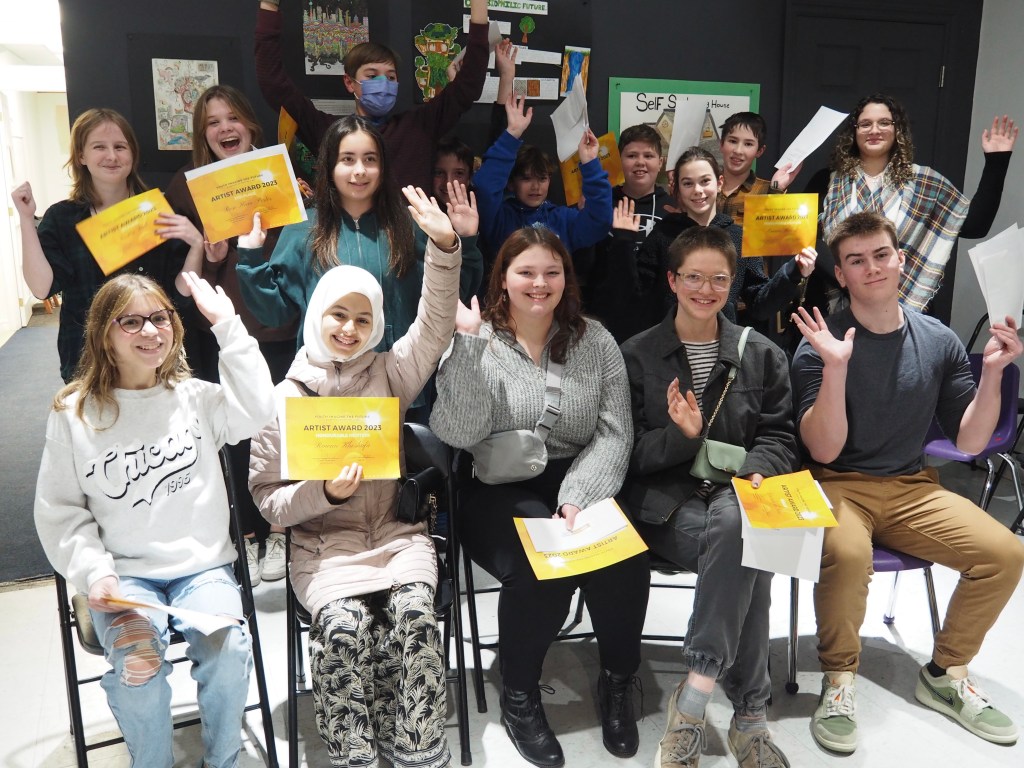
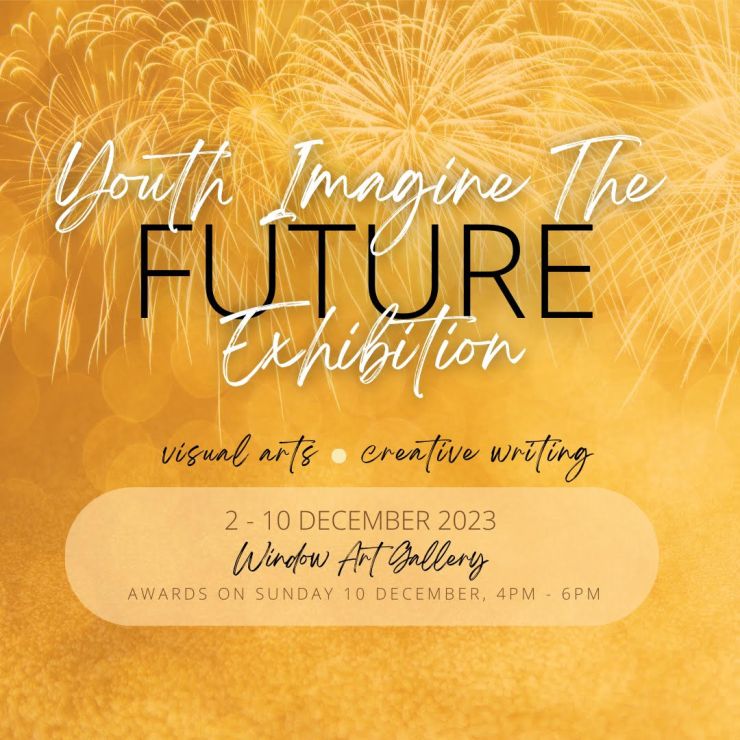
On the evening of Sunday, Dec. 10, 2021, young artists and writers were honoured at the Youth Imagine the Future (YIF) Award Ceremony at the Window Art Gallery.
For the past two Septembers, during the Youth Imagine the Future festival, local youth have been invited to design their own (better) believable future, make it socially equitable, and then use that as the setting for a fun short story – or create a piece of art.
According to a release from event organizers, the 2023 awards ceremony celebrated the nearly 70 stories and 40 art works submitted to this year’s festival. Students participated from Bayridge SS, LCVI, KSS, LaSalle SS, Holy Cross SS, Regiopolis-Notre Dame SS, Granite Ridge EC, Sydenham HS, Frontenac SS, Calvin Park PS, Loughborough PS, Southview PS, Central PS, École Sainte-Marie-Rivier, Kings Town School, Fairfield PS, Bayside SS, Trenton SS, École Cathedrale (Kingston), and North Addington EC.
Writer Abbie Miolée (LaSalle SS), and artist Caitlin Ball (Sydenham SS), each won a First Place award of a $500 GIC donated by the Kington Community Credit Union. Second to fifth-place winners each won $100 for writing (Jasper Lyon Wicke, Ivy Bjerknes, Holly Stephen, and Leila Lawrence-Montag) and artists (Alex Goddard, Rose Hum-Porter, Luke Peck, and John McNichols with Gavin Jones and Jaden Bicknell).
Article may continue below


Organizers shared that highlights from the ceremony included personal letters from professors of mycology, a signed novel by YA author Adan Jerreat-Poole, and warm, personal letters of congratulations from MP Mark Gerretsen and MPP Ted Hsu.
“These students did an amazing and inspiring job to create a believable, sustainable and just future and show it so creatively in a piece of art or in a short story. We had over 80 visitors to the [Window Art Gallery] this year who were cheered up by the display,” Jerri Jerreat, one of the festival organizers, shared with Kingstonist in an email.
“We will be showing a small selection of the art and writing at the City of Kingston’s New Year Levee on Jan 9th and Novel Idea will let us show it in a nice window display in February. We need our youth to think about these issues in a positive, solutions kind of way, and they are. They are thinking.”
Some of the student artwork will be on display at the Kingston Climate Change Symposium on Monday, Jan. 29, 2023, and then at The Bagel Shop (Kingston), at a Black Dog Hospitality restaurant, and later in Kingston City Hall.
Article may continue below
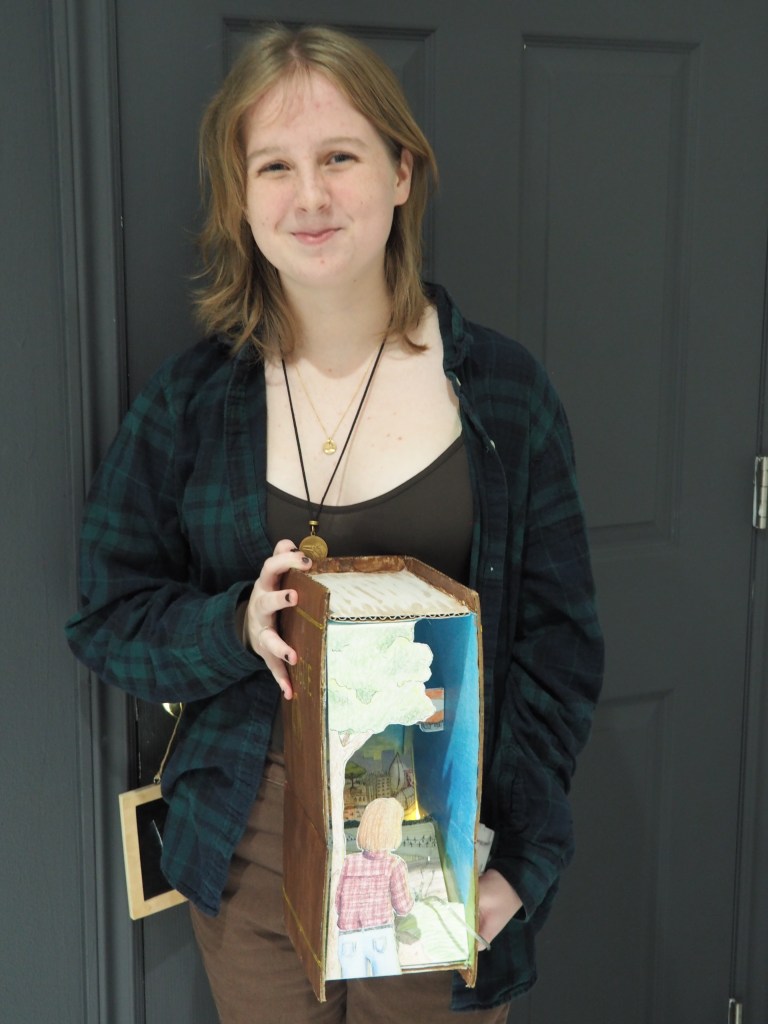
“I am blown away by the wisdom, insight, and passion of these creative youth!” shared Professor Heather McGregor of Queen’s University’s Faculty of Education.
Dr. Tiina Kukkonen, a professor of Visual Arts Education at Queen’s, echoed her colleague’s sentiments.
“What a spectacular show of creativity, innovation, and hope. We need those skills and mindsets for the future!” she said.
Another visitor to the KSOA gallery simply noted, “You give me hope,” organizers of the Youth Imagine the Future shared.
Article may continue below

According to the release, these awards were supported by Queen’s Faculty of Education, Providence Centre for Peace & Justice, Trailhead’s Eco fund, 350Kingston, and individual donors.
The Mission Statement of Youth Imagine the Future is:
- To encourage youth in our region to research and envision solutions to the Climate Crisis and a more socially equitable future.
- To allow our youth to have a voice in our community regarding their concerns about the environment and social equity issues.
- To create community: to bring adults and youth together to see and listen to each other over these large issues of the Climate Crisis and social equity.
- To help combat the rise of Climate Anxiety and Climate Depression among our youth by encouraging them to look toward solutions and help us to get there.
- To run a festival as a non-profit with the help of the community, offering solarpunk/hopepunk workshops and showing the community the ideas youth create both in art and in writing short stories.
- To foster artistic individuality and innovation in the arts, and literacy among youth.
For more information on this Kingston-based initiative, visit the Youth Imagine the Future website.
Second annual Kingston Youth Festival encourages hope for the future
Writers, artists receive awards for work depicting ways to imagine a better future
Author of the article:
Meghan Balogh
Published Dec 21, 2023 • 2 minute read The Kingston Whig-Standard
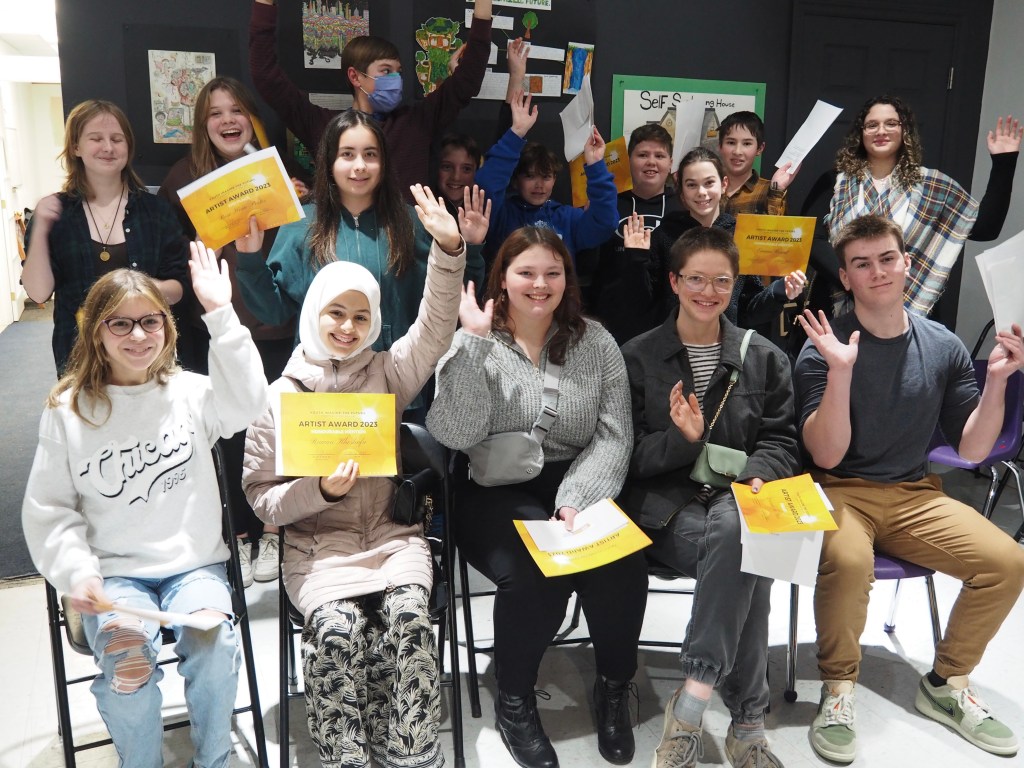
Some of the award winners for this year’s Youth Imagine the Future festival, which gives elementary and high school students the chance to write or create works of art depicting a better future. Award winners received their recognition during a ceremony at the Window Art Gallery in Kingston on Dec. 10.
Article content
When Jerri Jerreat founded the Youth Imagine the Future festival in 2022, she wanted to give young people a chance to imagine the future of our planet through a lens of hope.
Jerreat, a retired teacher, saw an opportunity to give young people a voice through the festival project.
“I wanted to give an opportunity for youth to think about the future in a kind of positive solution sort of way, and to really imagine a better future where communities work together,” she told the Whig-Standard on Wednesday.
Jerreat pointed out that recent studies from Canadian universities are showing a rise in climate anxiety and depression among young people, especially in high school and university-aged youth.
“Everyone needs climate education,” Jerreat admitted. “It’s part of our life. But we don’t just need to look at all the terrible things. We need to look at all the solutions that are actually being used around the world, quite successfully. Then maybe they could start imagining and thinking about a way to get to a better future.”
Jerreat has taken her “good news” climate education to 60 classrooms in the Limestone District School Board this fall, inviting students in those classes to submit artwork or written work exploring ideas surrounding a sustainable future — things such as electric vehicles, rooftop community gardens, solar power and more.
“It was believable, and it was really fun,” Jerreat said of the submissions.
On Dec. 10, the Youth Imagine the Future festival handed out more than 30 awards to honour the stories and vision demonstrated by youth from a number of local elementary and high schools during a ceremony at the Window Art Gallery in Kingston.
The awards ceremony celebrated the nearly 70 stories and 40 works of art that were submitted to this year’s festival, a news release from the festival said.
Those award-winning pieces will be available to view on the festival’s website in the near future, as well as in some public spaces in the new year.
The festival is promoting a genre of creative writing called Solarpunk, which takes the dystopian model and turns it on its head to look at brighter paths to the future.
“It’s more optimistic climate fiction,” Jerreat explained. “It’s not foolish, not magical solutions. I think we’ve had enough reading dystopian fiction. It’s time we need to see fiction set right in Kingston, where maybe in 40 years we’re living a little bit more co-operatively, with more little forests, more biodiversity.”
Jerreat is passionate about sharing this positive climate education with more students. She has prepared a workshop that’s available to any teacher who wants to invite her into a classroom to talk about the positive things that are happening right now to address climate change.
“These solutions are actually happening (in the world), but we’re not really hearing about them,” she said.
For more information, visit www.youthimaginethefuture.com.
https://youthimaginethefuture.com/
Have a look!
Preparing a new slideshow for delivering 1-hour workshops at high schools (& grade 7/8) across the broad Kingston region for YOUTH IMAGINE THE FUTURE–a Festival of Writing & Art. Very excited! – Jerri J
I’ll be offering a writers’ workshop on Solarpunk (inspiring climate fiction) at the WILD WRITERS LITERARY FESTIVAL this October, in Waterloo, Ontario. – Jerri J
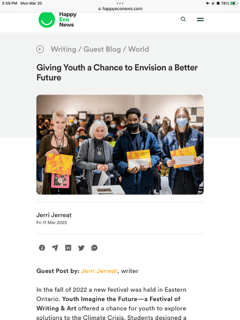
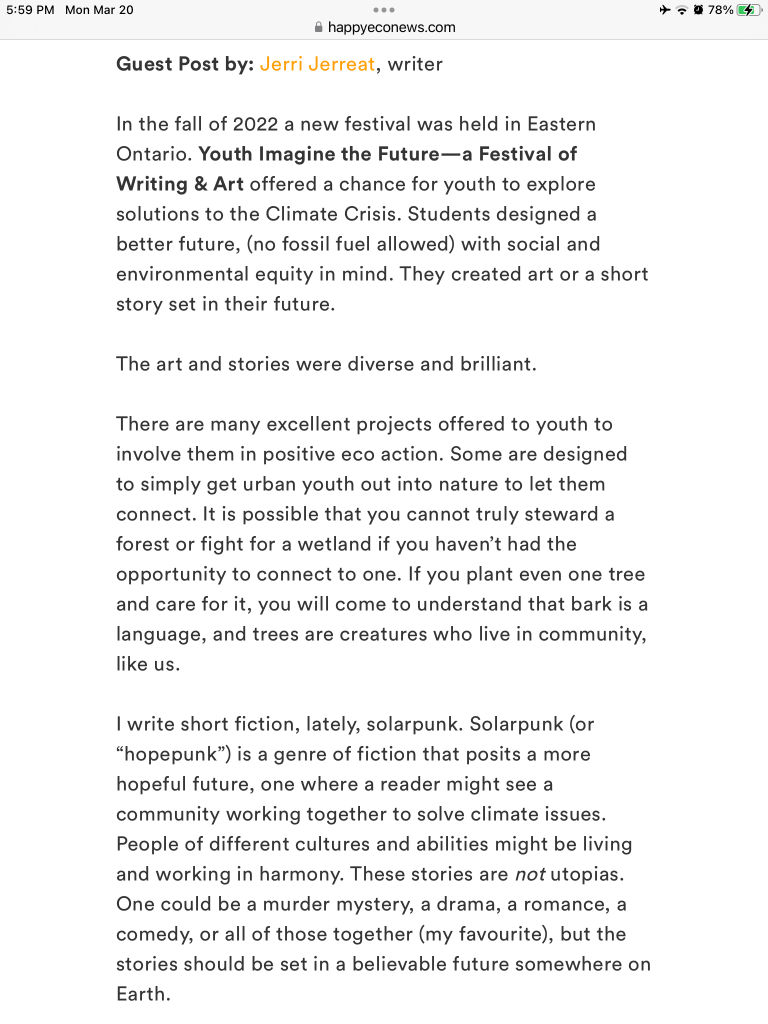
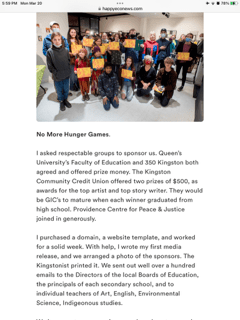
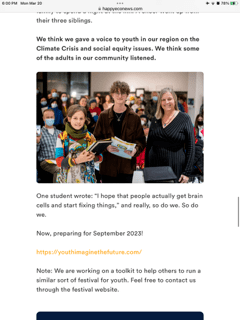
I had the honour of directing the “Youth Imagine the Future– a Festival of Writing & Art”, 2022. It invited youth 18 or younger living in Eastern Ontario (the region covered by the Limestone and Algonquin& Lakeshore School Boards), to research green technology and nature based solutions, and design a more hopeful future in regards to the Climate Crisis and social equity. Students then used their vision of a (better) future to create art or as a setting for a short story.
The stories and the art were absolutely breathtaking. Please check out the website: https://youthimaginethefuture.com/

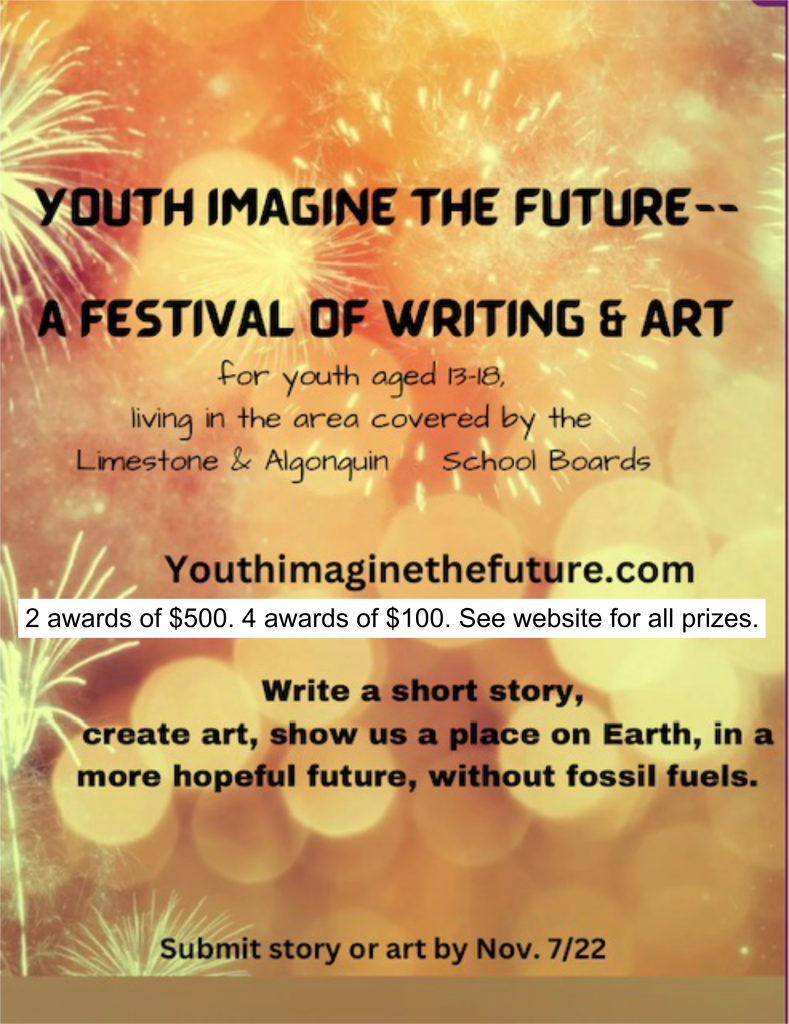
http://youthimaginethefuture.com
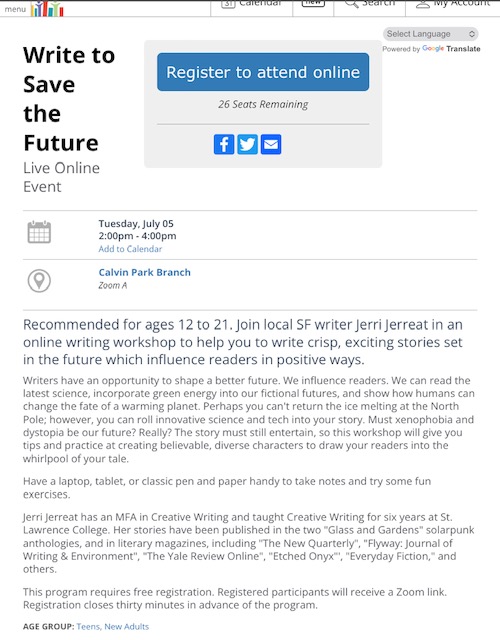
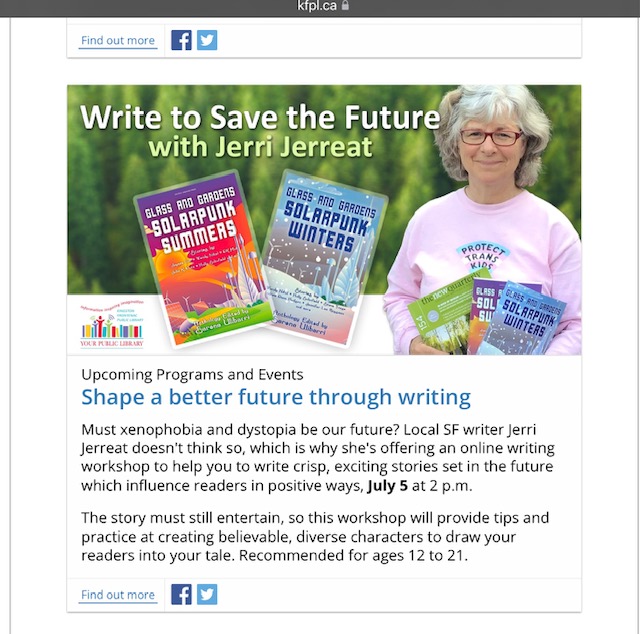
The Elementary Teachers Federation of Ontario, (ETFO) publishes an excellent magazine, with articles to inspire and make one think. I’m a proud ETFO member, delighted to have this article appear in their most recent issue.
Please google ETFO VOICE magazine if you would like to read my article about mentoring student activism properly. If you know a teacher, borrow the magazine to see several gorgeous photos of the students in the printed copy taken by Christine Cousins.
http://etfovoice.ca/feature/mentoring-student-activism
Below is a poor “copy-and-paste” offering of the piece.
http://etfovoice.ca/feature/mentoring-student-activism
FEATURE
Mentoring Student Activism: From Fear to Empowerment
JERRI JERREAT
Winter 2019
Tags: ActivismClassroom
The grade fours and fives at my school are taking on the province of Ontario. It didn’t start all at once; it crept up on us. Perhaps the most interesting right of Canadians, they agreed, was the right to protest peacefully. “And you don’t have to wait to be an adult to exercise that right,” I said casually. Lily spoke up. “Plastic,” she announced. “We should protest all the plastic in the ocean. It’s awful. We have to do something about it.”
Talking About Bad News
There are compelling reasons why we need to teach our elementary students about what some might dismiss as “bad news.”
The reality is students are bringing the news to school. They’re anxious. They overhear conversations about wars or mass shootings. Newcomer students arrive with nightmares of bombs. We might try to shield our younger students, but many are already grappling with the issues in the hallways. When Donald Trump was elected, I had to reassure grade twos that he wasn’t going to attack us. I don’t even teach grade two. Young students need to be reassured that they are safe, that something is being done to help and that it will get better. Juniors and intermediates need and want to start helping.
Students need to know the truth, not last century’s facts from old textbooks. We must teach the latest scientific facts about global warming and the results it will bring: more severe hurricanes, flooding, tropical diseases moving north and loss of stabilizing ice at both poles. Polar bears, lost. Coastlines, swallowed up. Already the island atoll country of Kiribati is disappearing under the rising ocean.
Scientists agree that increasing the planet’s temperature by 1.5 degrees is the tipping point toward disaster. Canada signed the Paris Accord to lower fossil fuel emissions. However, last summer, Montreal’s heat wave caused over 90 deaths and B.C. wildfires made asthma medications spike in Vancouver and filled Calgary with black smoke. This is real.
I think sometimes we underestimate the strength of our students. They are capable of becoming educated activists, even world changers. Look at what young people have accomplished recently: 15-year-old Greta Thunberg scolded the United Nations. (Show that video to your class.) Nearly 10,000 Australian students demanded action on climate change. Craig Kielburger fought to end child labour at age 12. Malala Yousafzai gave her first speech at 11. William Kamkwamba, 14, unable to afford school, built a wind turbine from an old bicycle and scrap metal. Boylan Slat started his ocean clean-up project at age 16. Students can change things.
In science, our students experiment, observe and learn to think for themselves. Embedded through that curriculum is a growing understanding of air, water, soil, energy, renewable energy and how we affect the planet. In our social studies curriculum, students explore how they’re connected to their communities, Canada and the world. We challenge them to see various sides of issues, understand their rights and responsibilities and become involved citizens. Even the arts curriculum document states that one idea underlying it is “making a commitment to social justice and dealing with environmental issues.”
Building Activism Into Classroom Learning
My first class at Elginburg District P.S. wrote letters to protest the lack of a school in Attawapiskat in 2009, their response to a news article I’d shared. A pipeline laid under the school had broken, spilling 95,000 litres of diesel fuel – back in 1979. If I’d merely read this depressing news to my students, it would have added to their anxiety. I presented it as a discussion topic, a chance to look at all sides. It was also an opportunity for action, for caring for others and making change.
When Justin Trudeau walked to work on his first day with the cabinet, my students watched. The cabinet was half women and represented the different communities that make up Canada. Some members had once been refugees; one used a wheelchair. We discussed it.
When the Canadian government invited 25,000 Syrian refugees to Canada, my class made a “Welcome to Canada!” banner the length of the room.
Encouraging Questions
After I bring in the primary sources to generate discussion, I encourage questions. When enthusiasm mounts, I send them off to do research. Finally, to leave them feeling empowered, I mentor them through a class project to address the issue they feel strongly about.
Lily suggested plastic bags. The other students agreed. Former MPP, Sophie Kiwala, came in to chat with all the grade five students about government. Lily told her we were going to ask Kingston to ban plastic bags. Kiwala congratulated them, then asked, “Why only Kingston? Why not Ontario?”
That led to the grade fives researching the reasons behind banning plastic bags, how other cities were doing it, which type was wisest to target. I suggested sources that were reputable, such as the United Nations, CBC and Ecojustice reports. I steered them away from gory photos or sensational reporting. It was a mini lesson in being critical of media. They kept rushing up to me in pairs, clutching an iPad with shocking facts about the size of islands of plastic in the ocean or numbers of plastic bags used in a year.
I brought in Ontario peppers wrapped in plastic over styrofoam and a mix of takeout containers to deepen our discussions. It turned out that coloured and black plastics are not even recyclable in our area. Comparing the takeout containers available already, they voted to add styrofoam to their petition. Polystyrene is our new word.
As teachers, we must address global issues. What we choose to share will depend on our students’ age and maturity, but how we share world news is critical. I showed news footage of the 1985 Haida logging protest. Grade 5 students wrote a journal entry from each side, then chose a role and sat at a “debating table.” They each had a minute to give their point of view. The grade 4s, as the government, listened. Then the 5s left to come up with a solution, which the 4s voted on. In that case, they learned the government had decided to create a 1,500 square kilometre National Park Reserve that would protect salmon streams. Logging could continue, but at a rate agreeable to both, and the islands dropped their colonial name and became Haida Gwaii. We clapped.
We repeated the process for the contemporary issue of salmon farming, and the Tiny House Warriors, Secwepemc people protesting a pipeline crossing their alpine territory. These Canadians inspire us. In these exercises, my students have learned there are different sides to all issues, governments are imperfect and regular people can make a difference.
Engaging Your Students as Change Makers
Naomi Klein has said that we need to inspire a love of nature in children so they will become intelligent activists later on, working from a place of connection and respect. We need to take our classes into conservation areas often, let them wonder.
It is crucial to instill a reverence for nature in every child but also to foster critical thinking. You can show breaking news stories about injustices, both climate and social, as long as you also show those who fight it, those who offer hope every day and encourage your students to find a way to get engaged and help.
Climate justice and social justice are intertwined. Both are targets of right wing politics and corporate greed. In school, we’re teaching our students to rejoice in our multicultural heritage, to reject rigid thinking and prejudice and to become wise stewards of the planet. The current Ontario government closed the independent Environmental Commissioner’s office and cut funding to renewable energy projects. Issues like these are perfect to explore in class.
Which brings us to taking on the province of Ontario. Will we convince this government to ban single use plastic and polystyrene? I don’t know. But my students will have tried, valiantly, to fight for the planet. MPP Nathalie Des Rosiers has offered to present our petitions to Queens Park and table a law that my students have written. A law that my students have written. How empowering is that?
Love of our planet, joy in stewardship, empathy and caring for others, civic rights and how to stand up against injustice – that is what we need our students to learn.
Update November, 2019
Provincially, the petition was read aloud twice in the Ontario legislature by MPP Des Rosiers and the NDP, Liberal and Green members all expressed their support. The Environment Minister spoke privately with Des Rosiers and did actually show interest in this movement, if not intention. Since our petition, more studies have shown the terrible effects of plastic in our lakes and waterways. There are a couple of videos now on YouTube about the petition circulating. The best one is the short one of a few of the students speaking to Ontario. They wrote their sentences themselves and they are endearing and powerful.
Jerri Jerreat is a member of the Limestone Teacher Local.
 Jerri Jerreat, Author